Lisbon as a Shared Table: Fundación Caja Castellón Promotes a Cultural Dialogue Between the Mediterranean and the Atlantic
![[Img #109356]](http://el7set.es/upload/images/05_2026/4996_1.jpg)
Fundación Caja Castellón continues to strengthen its commitment to the territorial articulation of culture by building connections between peripheral yet deeply active artistic scenes linked to contemporary European creation. In this context, a delegation from the institution recently carried out a working visit to Lisbon with the aim of reinforcing institutional relationships and opening new avenues of collaboration between the Valencian cultural sphere and the Portuguese art scene.
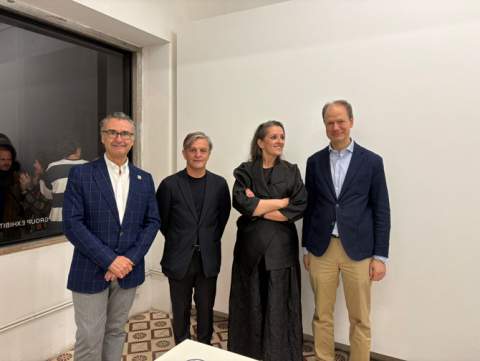
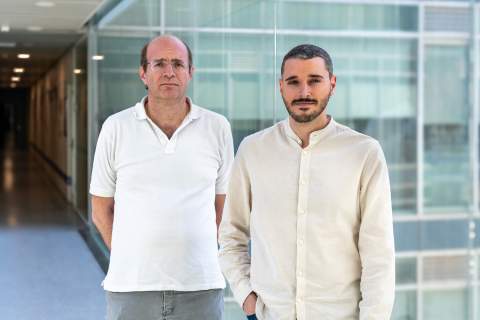
The visit included the participation of Luis Prados Covarrubias, Cultural Counsellor of the Spanish Embassy in Portugal; Leopoldo Monfort and Alfredo Llopico on behalf of Fundación Caja Castellón; gallerist and curator Mercedes Cerón; and Rute Reimão, curator of Galeria Santa Maria Maior in Lisbon. The meeting initiated a strategic conversation around the possibilities of cooperation between the Levantine Mediterranean façade and Atlantic Lisbon — two territories that share cultural dynamics situated outside Europe’s major artistic centres, yet increasingly defined by their capacity for innovation and cultural production.
The central focus of the trip was the visit to the group exhibition O Banquete (1), presented at Galeria Nave in Lisbon. The project operates simultaneously as an exhibition, a platform for critical thought, and a relational space connecting artists, institutions and independent cultural agents. Beyond the viewing of artworks, the visit opened future lines of collaboration between Valencian and Portuguese artists, particularly in the fields of curatorial exchange and contemporary production networks.
The exhibition brings together Portuguese artists João Campolargo Teixeira, Beatriz Capitulé, Sebastião Castelo Lopes, André Filipe Rodrigues, Maria Inês Gomes, João Marques, Maria Máximo, Beatriz Neto, Francisco Pinto de Almeida, Leonardo Quintaneiro and André Vaz, selected from 96 proposals submitted through an open call. The exhibition offers a precise overview of current emerging Portuguese artistic practices, articulated through hybrid languages and open processes that address themes related to the body, memory, territory, spirituality and ecological materiality.
Curated by Mercedes Cerón together with Catarina Pedroso, the project also incorporates an expanded committee composed of artists, curators and institutional representatives from different European contexts. The participation of figures connected to Lisbon, Berlin and Castellón introduces a particularly relevant transnational dimension at a moment when many European peripheral art scenes are seeking to build horizontal models of cultural cooperation.
One of the central elements of O Banquete (1) is a long shared table that organises all the works within the same relational space. The curatorial decision goes beyond formal considerations, transforming the table into a metaphor for a provisional community in which artworks cease to function as isolated entities and instead coexist within a shared ecosystem of resonances and tensions.
The reference to Plato’s Symposium becomes therefore especially meaningful: just as knowledge in the classical dialogue emerges through conversation and exchange between different voices and sensibilities, the exhibition understands artistic space as a territory of coexistence where meaning arises precisely through contact with difference.
The Lisbon visit also highlighted the strong affinities between the cultural scenes of the Levantine Mediterranean and Atlantic Portugal. Both share a peripheral position in relation to Europe’s major artistic centres, while simultaneously developing their own increasingly flexible, collaborative and relational models of cultural production.
In this sense, Fundación Caja Castellón’s involvement in initiatives of this kind points toward new forms of cultural diplomacy based not only on institutional representation, but on the effective construction of working networks among artists, spaces and territories.
O Banquete (1) will remain open in Lisbon until June 26 and stands as a particularly eloquent image of a cultural ecosystem currently under construction: heterogeneous, at times precarious, yet sustained by the possibility of generating meaningful connections between practices, institutions and diverse communities. A shared table that, rather than closing a conversation, appears to inaugurate one.
Fundación Caja Castellón continues to strengthen its commitment to the territorial articulation of culture by building connections between peripheral yet deeply active artistic scenes linked to contemporary European creation. In this context, a delegation from the institution recently carried out a working visit to Lisbon with the aim of reinforcing institutional relationships and opening new avenues of collaboration between the Valencian cultural sphere and the Portuguese art scene.
The visit included the participation of Luis Prados Covarrubias, Cultural Counsellor of the Spanish Embassy in Portugal; Leopoldo Monfort and Alfredo Llopico on behalf of Fundación Caja Castellón; gallerist and curator Mercedes Cerón; and Rute Reimão, curator of Galeria Santa Maria Maior in Lisbon. The meeting initiated a strategic conversation around the possibilities of cooperation between the Levantine Mediterranean façade and Atlantic Lisbon — two territories that share cultural dynamics situated outside Europe’s major artistic centres, yet increasingly defined by their capacity for innovation and cultural production.
The central focus of the trip was the visit to the group exhibition O Banquete (1), presented at Galeria Nave in Lisbon. The project operates simultaneously as an exhibition, a platform for critical thought, and a relational space connecting artists, institutions and independent cultural agents. Beyond the viewing of artworks, the visit opened future lines of collaboration between Valencian and Portuguese artists, particularly in the fields of curatorial exchange and contemporary production networks.
The exhibition brings together Portuguese artists João Campolargo Teixeira, Beatriz Capitulé, Sebastião Castelo Lopes, André Filipe Rodrigues, Maria Inês Gomes, João Marques, Maria Máximo, Beatriz Neto, Francisco Pinto de Almeida, Leonardo Quintaneiro and André Vaz, selected from 96 proposals submitted through an open call. The exhibition offers a precise overview of current emerging Portuguese artistic practices, articulated through hybrid languages and open processes that address themes related to the body, memory, territory, spirituality and ecological materiality.
Curated by Mercedes Cerón together with Catarina Pedroso, the project also incorporates an expanded committee composed of artists, curators and institutional representatives from different European contexts. The participation of figures connected to Lisbon, Berlin and Castellón introduces a particularly relevant transnational dimension at a moment when many European peripheral art scenes are seeking to build horizontal models of cultural cooperation.
One of the central elements of O Banquete (1) is a long shared table that organises all the works within the same relational space. The curatorial decision goes beyond formal considerations, transforming the table into a metaphor for a provisional community in which artworks cease to function as isolated entities and instead coexist within a shared ecosystem of resonances and tensions.
The reference to Plato’s Symposium becomes therefore especially meaningful: just as knowledge in the classical dialogue emerges through conversation and exchange between different voices and sensibilities, the exhibition understands artistic space as a territory of coexistence where meaning arises precisely through contact with difference.
The Lisbon visit also highlighted the strong affinities between the cultural scenes of the Levantine Mediterranean and Atlantic Portugal. Both share a peripheral position in relation to Europe’s major artistic centres, while simultaneously developing their own increasingly flexible, collaborative and relational models of cultural production.
In this sense, Fundación Caja Castellón’s involvement in initiatives of this kind points toward new forms of cultural diplomacy based not only on institutional representation, but on the effective construction of working networks among artists, spaces and territories.
O Banquete (1) will remain open in Lisbon until June 26 and stands as a particularly eloquent image of a cultural ecosystem currently under construction: heterogeneous, at times precarious, yet sustained by the possibility of generating meaningful connections between practices, institutions and diverse communities. A shared table that, rather than closing a conversation, appears to inaugurate one.